Data & AnalyticsSeptember 3, 2026
How Much Does a Power BI Dashboard Cost in Saudi Arabia? (2026 Pricing Guide)
H
Hamrix Editorial
Power BI itself is cheap licensing runs $14 to $24 per user per month. The cost people actually mean when they ask this question is dashboard development: the data pipeline, the compliance work, the Arabic UI, and the ongoing support. That varies a lot more, and vague quotes are one of the most common frustrations we hear from Saudi organisations comparing vendors.
In plain English
A single-department Power BI dashboard in Saudi Arabia typically starts around SAR 25,000. A full enterprise programme with NDMO compliance, government data integration, and Arabic-first reporting runs SAR 75,000-150,000+. Where you land depends mostly on how many data sources you're connecting and whether NDMO compliance is required.
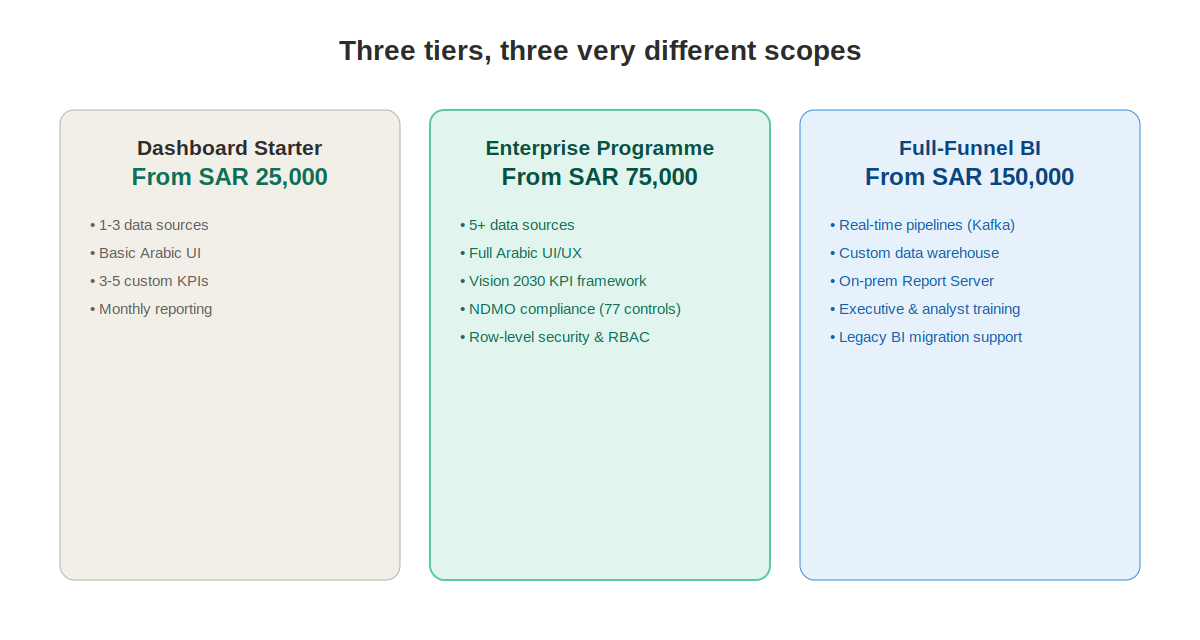
Single-department starter from SAR 25,000. One to three data sources, basic Arabic UI support, three to five custom KPIs, monthly reporting. This is the right starting point for a team new to Power BI or piloting BI in one function before rolling it out wider.
Enterprise programme from SAR 75,000. Five or more data sources, full Arabic UI/UX, a Vision 2030 KPI framework, NDMO compliance mapped across all 77 controls, row-level security and role-based access control, and quarterly automated reporting. This is where most government entities and larger enterprises land.
Full-funnel BI from SAR 150,000. Real-time data pipelines, a custom data warehouse, on-premises Power BI Report Server deployment for Restricted or Confidential data under NDMO classification, executive and analyst training, and migration support from legacy BI tools like Tableau or Qlik.
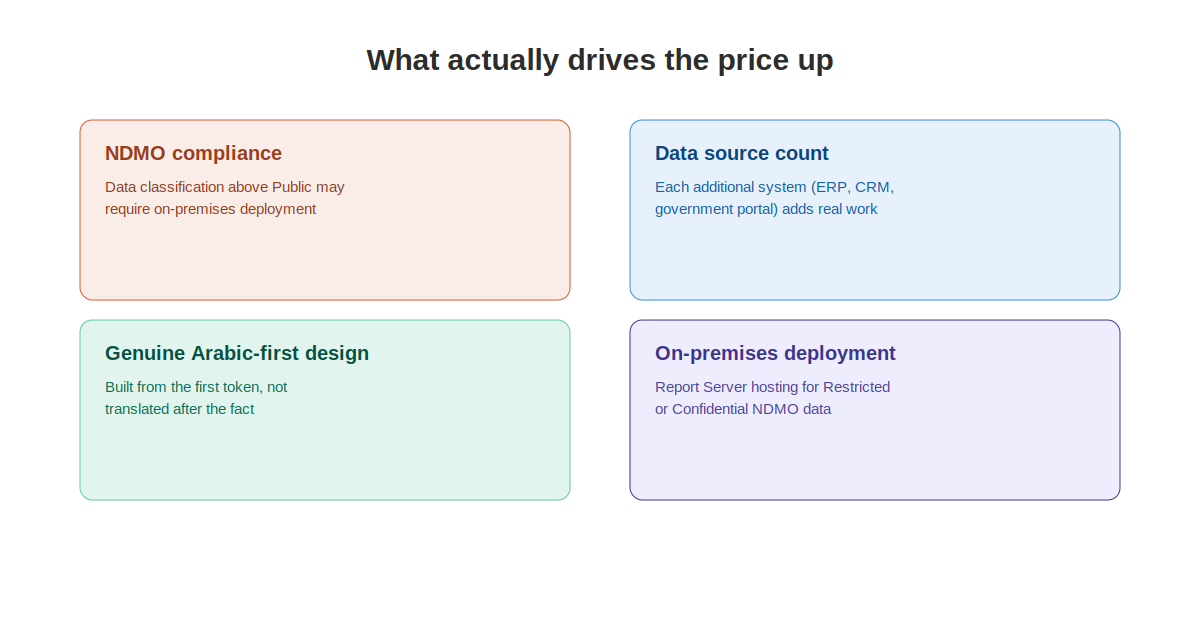
NDMO compliance requirements. If your data includes anything classified above Public under Saudi's National Data Management Office framework, you're looking at additional work: proper data classification, potentially on-premises Report Server deployment instead of cloud hosting, and compliance documentation your legal or governance team can review. This is the single biggest cost driver for government and regulated-sector clients.
Number and complexity of data sources. Connecting to one clean database is very different from integrating five systems ERP, CRM, government portals, and legacy spreadsheets someone's been maintaining by hand for years. Each additional source adds real integration work, not just a checkbox.
Genuine Arabic-first design, not a translation pass. Building an Arabic UI from the first design decision proper RTL layout, Arabic typography, bilingual report labelling takes more work than bolting Arabic text onto an English-first dashboard afterward, but it's also the difference between a dashboard your Arabic-speaking leadership actually uses and one they route around.
On-premises vs. cloud deployment. Power BI Report Server for on-premises hosting, required for Restricted or Confidential NDMO-classified data, adds infrastructure and deployment complexity that a standard cloud-hosted Power BI Service dashboard doesn't need.
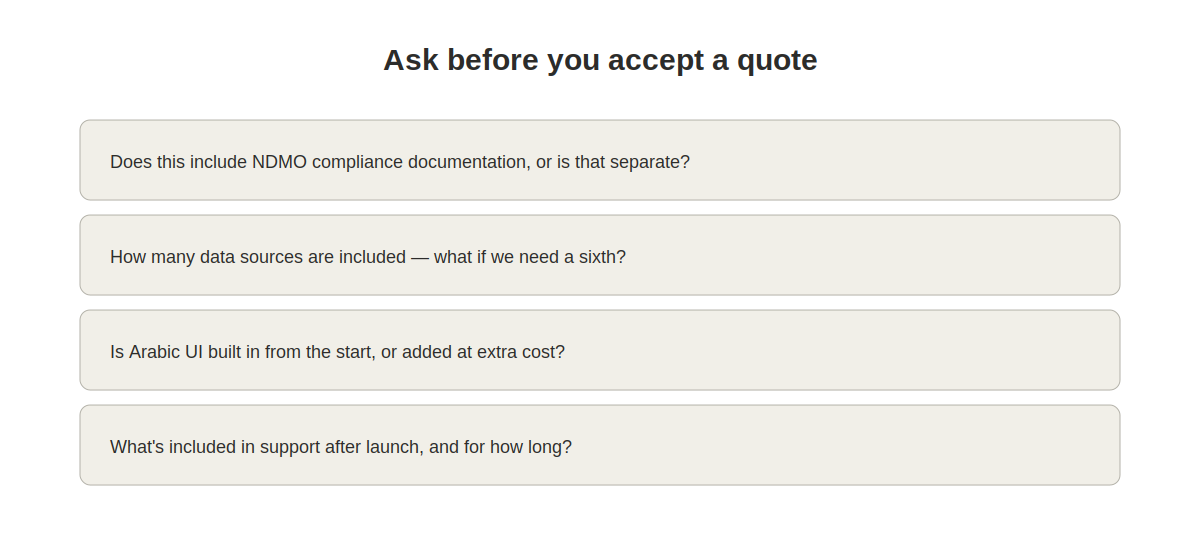
Does this price include NDMO compliance documentation, or is that a separate add-on discovered later? How many data sources are actually included, and what happens if we need a sixth? Is Arabic UI built in from the start, or added afterward at extra cost? What's included in ongoing support after launch, and for how long?
A vendor who can't answer these clearly before quoting is usually a vendor whose real price you'll only discover mid-project.
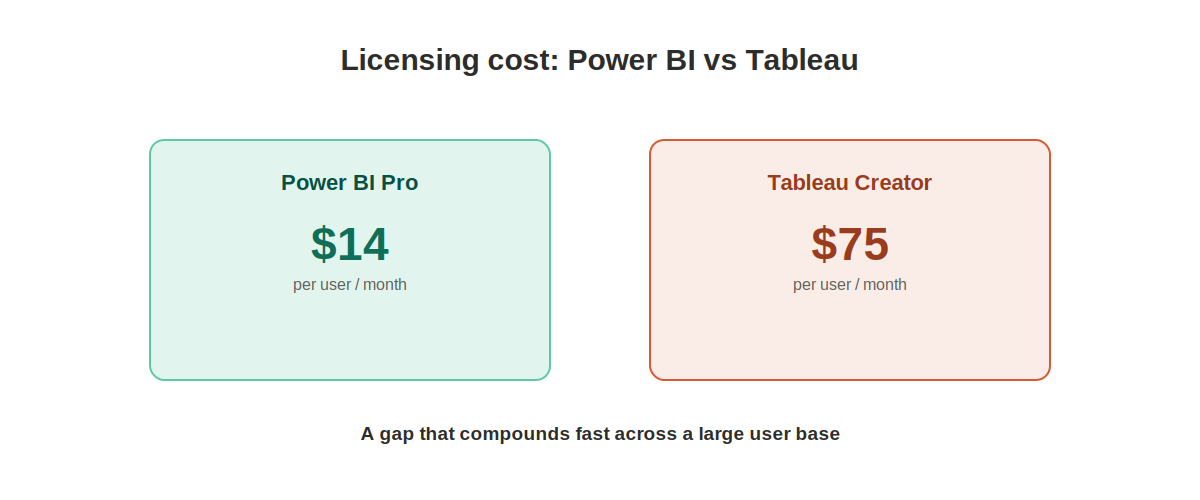
If you're currently on Tableau and evaluating a switch, the licensing math is worth factoring into your total cost comparison: Power BI Pro runs $14/user/month against Tableau Creator's $75/user/month a gap that compounds fast across a large user base, and one reason Tableau to Power BI migration has become a common request among Saudi enterprises reassessing their BI spend.
We scope pricing after understanding your real data sources, compliance requirements, and reporting needs not before. Book a free consultation and get a straight answer.
Book a Free Consultation →