UI/UX DesignMay 21, 2026
The Complete Guide to Arabic RTL UI Design in Dubai

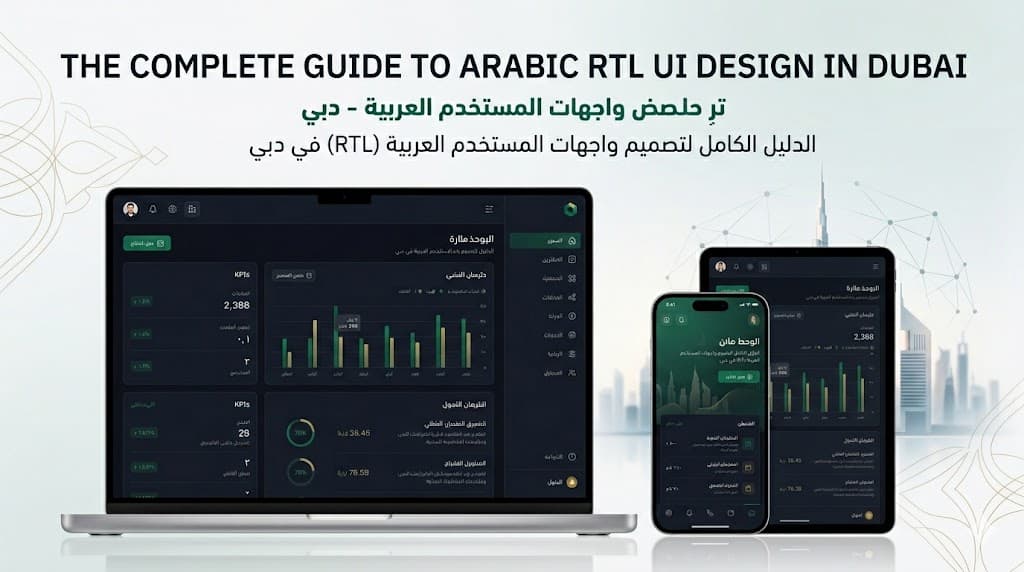

When global brands expand into the Middle East, they often make a critical and expensive mistake: they assume that localizing their software simply means translating the text and clicking an "RTL" (Right-to-Left) toggle in their framework. This fundamental misunderstanding of Arabic digital culture results in broken interfaces, plummeting conversion rates, and a deep alienation of the local user base. A true RTL UX design Dubai strategy requires a comprehensive rethinking of layout, typography, interaction patterns, and cultural context.
In this guide, we explore the exact methodologies we use to build high-performance, culturally resonant, and technically flawless Arabic interfaces. If you are targeting users in the UAE, Saudi Arabia, or the broader GCC, this is your blueprint for bilingual design success.
The concept of "mirroring" implies that an Arabic interface should be an exact reflection of the English interface. While the general flow of content indeed flips from Left-to-Right (LTR) to Right-to-Left (RTL), many elements categorically should not be mirrored. When global agencies treat Arabic UI design as a simple CSS transform, the results are catastrophic.
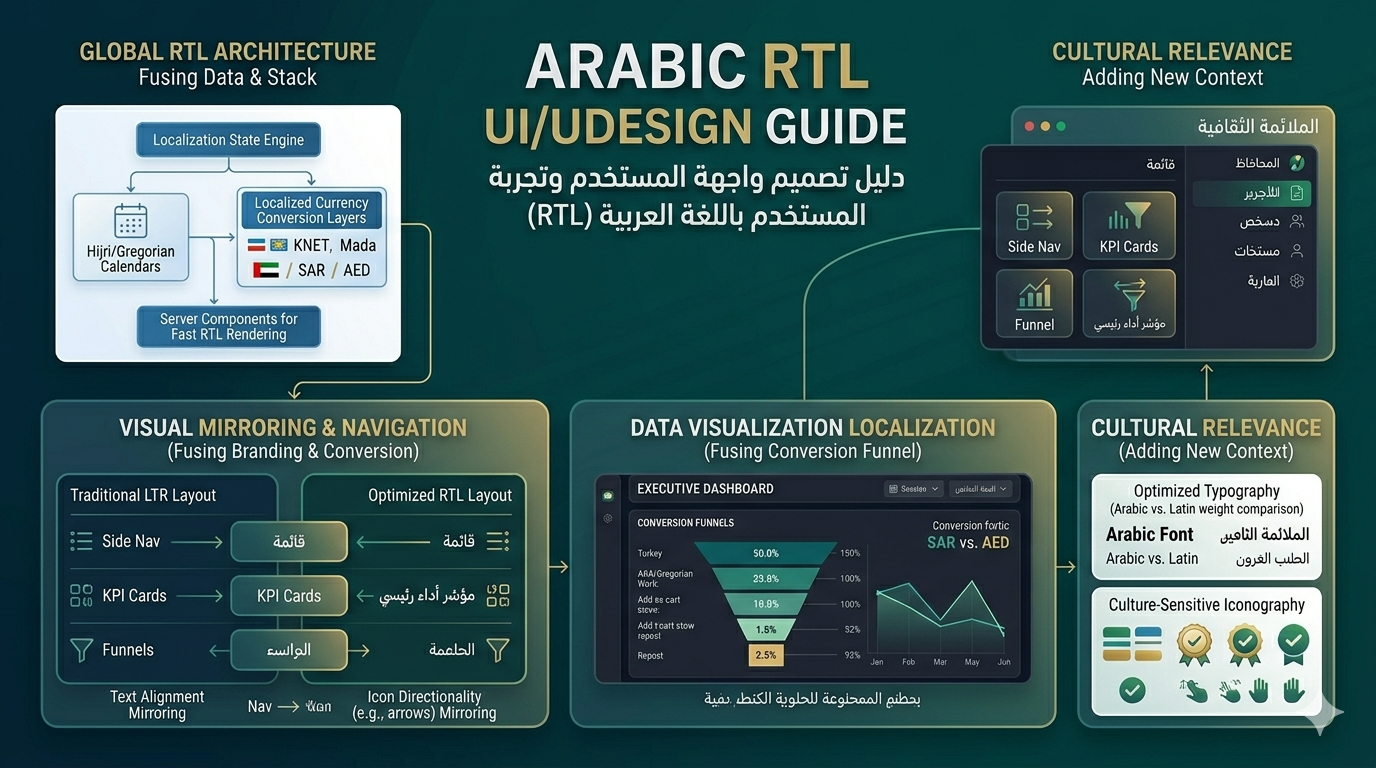
Common mirroring failures include:
Arabic is a cursive script, meaning that letters connect to one another. This fundamental characteristic changes all the rules regarding typography in web design.
Arabic characters generally require more vertical space than Latin characters due to the presence of intricate ascenders and descenders. An English interface might look perfectly balanced with a line-height of 1.5, but applying that same CSS rule to an Arabic font will often result in overlapping lines and terrible legibility. You must define specific typographic tokens for your RTL CSS.
When selecting fonts for a bilingual platform, harmony is key. You cannot pair a highly geometric English sans-serif (like Inter or Roboto) with a traditional, calligraphic Arabic font without causing severe visual dissonance. Modern web development in Dubai demands carefully paired typefaces. Popular Arabic geometric fonts like Cairo, Tajawal, or IBM Plex Sans Arabic pair beautifully with modern Latin equivalents.
True RTL UX design Dubai goes beyond the visual layer; it permeates the interaction layer.
In mobile applications, swipe gestures must be inverted. If a user swipes right-to-left to delete an email in the English version, they intuitively expect to swipe left-to-right to perform the same action in the Arabic version. Similarly, bottom navigation bars must be reordered, with the "Home" tab typically moving to the far right.
Localization is not just about words. The imagery, iconography, and avatars used throughout your application must resonate with the local demographic. Using stock photos of Western business settings for an app targeting Emirati consumers breaks immersion immediately. A specialized design agency ensures that the visual assets reflect the diversity, dress codes, and architectural environment of the UAE.
Building a scalable bilingual system requires a robust architecture. Hardcoding RTL overrides into your stylesheets is a recipe for technical debt. Instead, we utilize CSS logical properties (like margin-inline-start instead of margin-left). This modern approach allows the browser to automatically handle the spatial orientation based on the dir="rtl" attribute on the HTML tag, drastically reducing the amount of CSS required.
The UAE is a premium market with high customer acquisition costs. If your Arabic interface feels like an afterthought, your users will notice immediately, and they will abandon your platform. Investing in native RTL design is not an optional localization cost; it is the core driver of growth in the Middle East.
Don't rely on automated translations and CSS flipping. Get a comprehensive RTL UX audit from the experts at Hamrix.
Request a UX Audit
Full-Stack Developer with 4+ years of experience delivering SEO-ranked, high-performance web architectures and enterprise SaaS, FinTech & PropTech applications. Founder & CTO at Hamrix.
View Profile →