UI/UX DesignSeptember 3, 2026
How to Choose a UI/UX Design Agency in Dubai: What Actually Matters in 2026


Search "UI UX design agency Dubai" and you'll get pages of results that all promise the same things: "user-centered design," "beautiful interfaces," "we understand your users." None of that tells you anything useful about who's actually worth your budget. This is a practical breakdown of what to check before you sign anything written for anyone comparing agencies right now, not just for people who land on our own service page.
In plain English
A good UI/UX agency in Dubai should be able to answer four questions clearly: what does this actually cost, how do you handle Arabic content, what happens if my product needs regulatory sign-off, and can you show me real UAE work not just a generic portfolio. If an agency dodges any of these, that's worth noting.
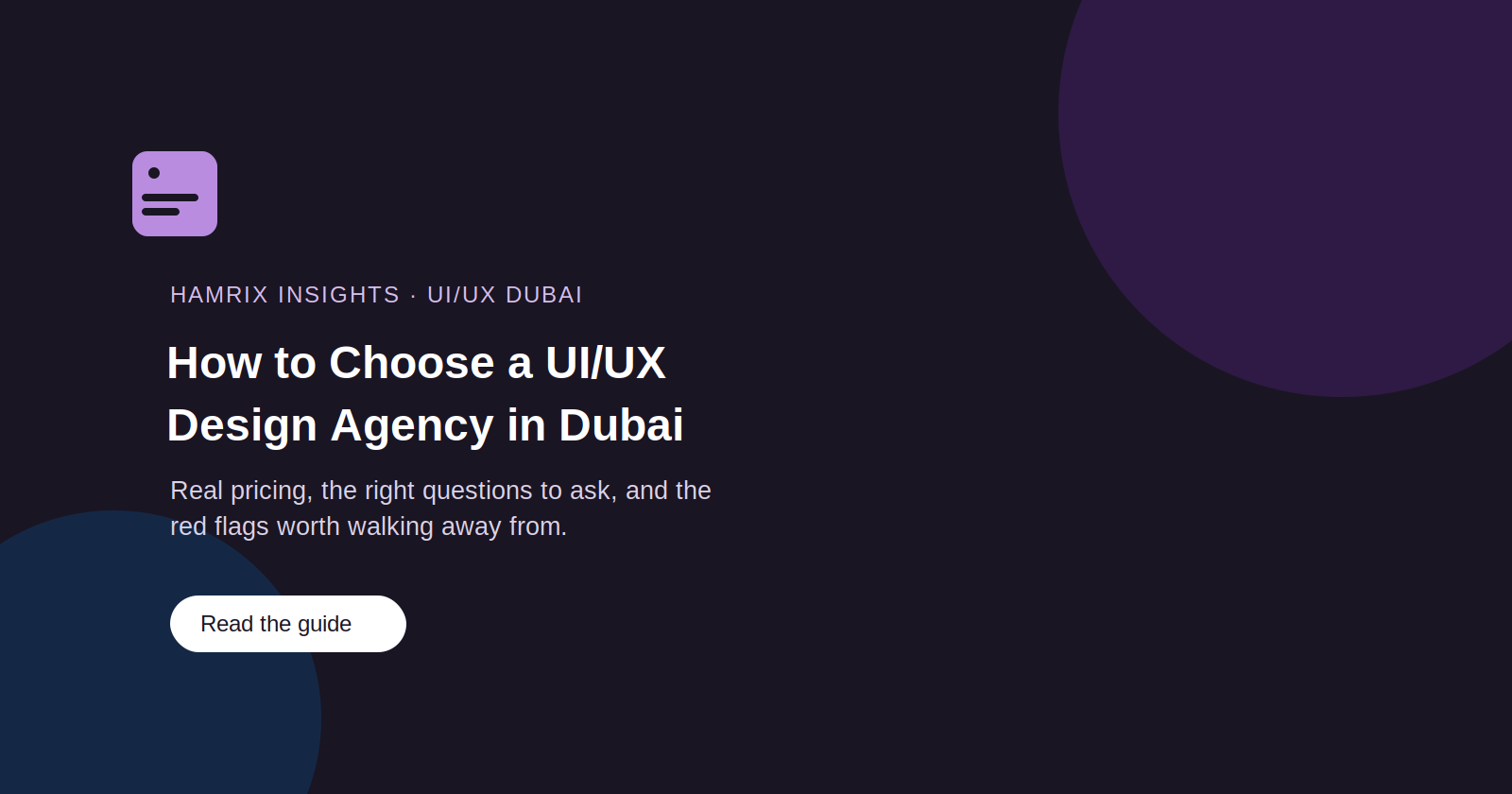
Pricing in this market varies more than most buyers expect, and vague quotes are one of the biggest sources of frustration later. As a general benchmark, UI/UX design work in Dubai typically ranges from around AED 18,000 for a focused product sprint up to AED 150,000+ for a full enterprise design system engagement and where an agency sits in that range should be clear before you commit, not negotiated after the fact.
Engagement structure matters as much as the number. Most agencies offer some version of three models: a dedicated team working exclusively on your product on a monthly retainer, a fixed-scope project with a defined deliverable and IP transfer at the end, or fractional consultancy for teams that need senior UX direction without a full build. Ask specifically which model you're being quoted, because "AED 40,000" means something very different depending on which one it's attached to.
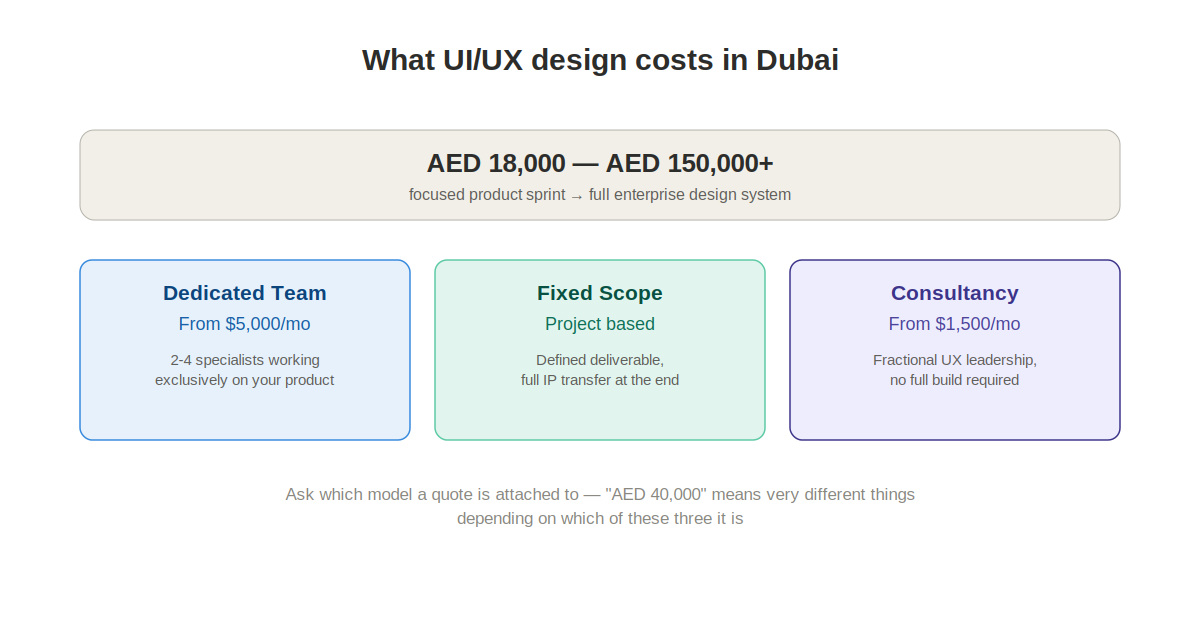
Do they understand Arabic as a design language, not a translation task? This is the single biggest quality gap in the Dubai market. A lot of agencies design in English first, then hand the Arabic version to a translator which produces layouts that don't account for right-to-left reading direction, text expansion, or the typographic conventions Gulf Arabic readers actually expect. Ask to see Arabic-first work specifically, not an English mockup with Arabic text dropped in.
Do they know what regulatory sign-off actually requires? If you're building anything in fintech, healthtech, or a government-adjacent product, your UX decisions aren't purely aesthetic consent flows, disclosure language, and accessibility all get reviewed by someone before launch. An agency with no experience in DIFC-regulated fintech UX or TDRA-style compliance requirements will design something that looks fine and then gets sent back for rework, at your cost and on your timeline.
Will they audit before they redesign? If you already have a live product, a competent agency should offer a standalone UX audit option heuristic review, real user behaviour data, a prioritised list of what's actually broken before pushing you into a full rebuild you might not need. An agency that jumps straight to "let's redesign everything" without looking at what's currently working is optimising for a bigger invoice, not your actual problem.
Can they show real UAE-market work? Generic international portfolios don't tell you much about whether an agency understands how Dubai's bilingual, high-expectation user base actually behaves. Ask for UAE-specific case studies, not just a global highlight reel.
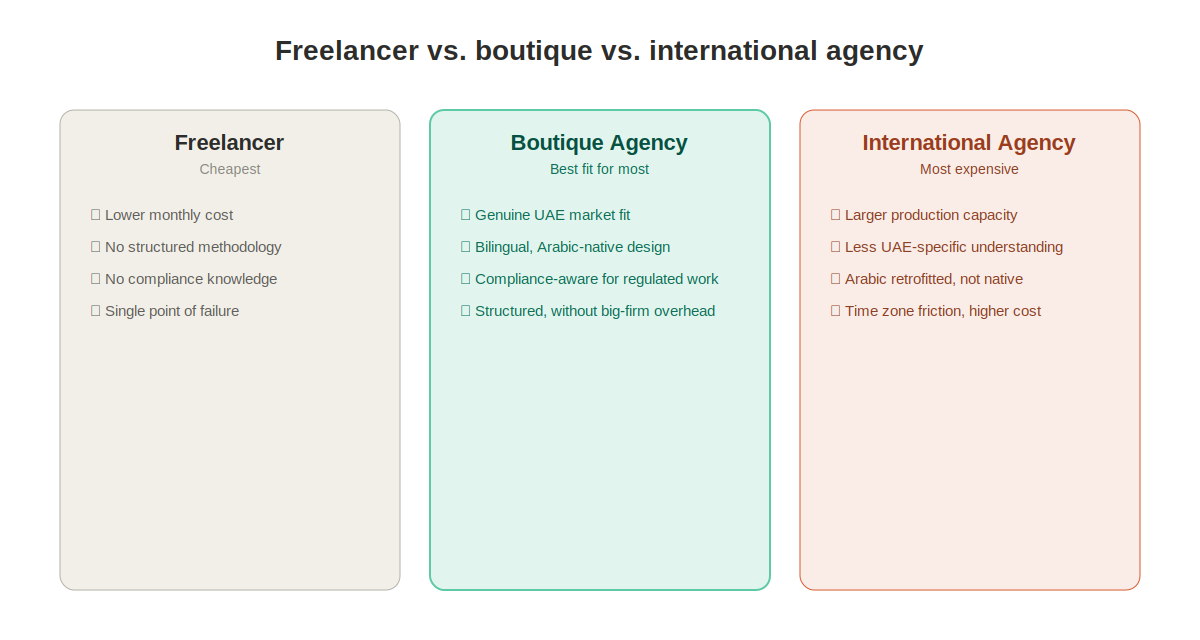
Each option trades off differently, and the right choice depends on what you're actually building:
Freelancers are the cheapest option and can work well for small, well-defined jobs. The trade-off is real: no structured methodology, no regulatory or compliance knowledge if you need it, and a single point of failure if they're unavailable mid-project.
Boutique UAE-focused agencies typically sit in the middle genuine local market understanding, bilingual design capability, and enough structure to handle compliance-sensitive work, without the overhead of a large firm.
Large international agencies bring bigger production capacity but often come with less UAE-specific market understanding, generic design systems retrofitted for Arabic rather than built for it, time zone friction, and meaningfully higher costs for comparable output.
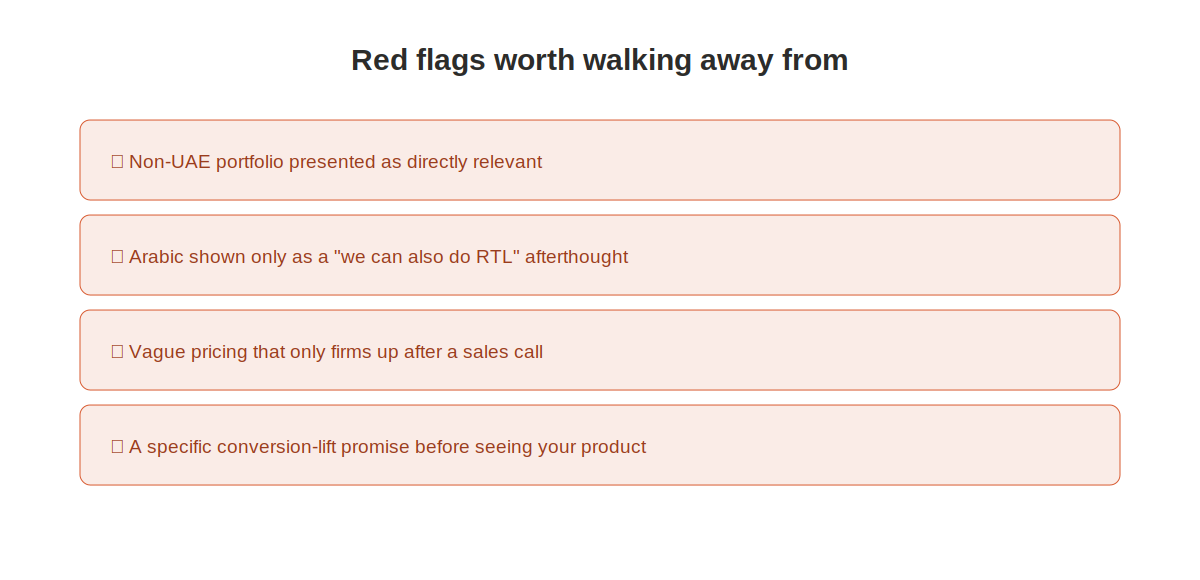
A portfolio full of non-UAE work presented as directly relevant. Arabic shown only as a "we can also do RTL" afterthought rather than a genuine design discipline. Vague pricing that only firms up after a sales call. No mention of compliance or accessibility if your product is in a regulated sector. And any agency promising a specific conversion or engagement lift without having seen your actual product or users first that's a marketing number, not a real estimate.
Not every product needs this a straightforward marketing site or basic app doesn't carry the same requirements. But if you're building for DIFC-regulated fintech, a government-adjacent portal, or anything handling sensitive user data, this isn't optional. Interfaces in these categories get reviewed against specific accessibility and disclosure standards before launch, and an agency without direct experience in this space will cost you a rework cycle you didn't budget for. If that's your situation, it's worth asking directly about DIFC/DFSA and TDRA-style compliance experience before you sign anything not discovering the gap after your first compliance review.
If you'd rather have this evaluated properly than compare pitch decks, our UI/UX design agency in Dubai team offers a free UX discovery call to walk through exactly this including whether your product needs regulatory-aware design at all, honestly, before quoting anything.
We'll walk through your actual product on a free 45-minute discovery call no pitch deck, no retainer commitment and tell you honestly what it needs.
Request a Free UX Discovery Call →
Full-Stack Developer with 4+ years of experience delivering SEO-ranked, high-performance web architectures and enterprise SaaS, FinTech & PropTech applications. Founder & CTO at Hamrix.
View Profile →