SEOAugust 28, 2026
The Day Google Stopped Showing You the Real Link (And How to See It Yourself)

Open Google right now and search for hamrix.com. Find our result, right-click it, and choose "Copy link address" instead of clicking it. Paste that copied link into a notes app or your browser's address bar without pressing enter.
You will not see https://hamrix.com. You'll see something that starts with https://www.google.com/url?q=https://hamrix.com... or, on the newer rollout, https://www.google.com/goto?... with our actual domain buried inside as an encoded parameter.
That's not a bug, and it's not specific to us it now happens on essentially every organic result on Google. Try it again with any other website's name and you'll see the exact same pattern. This one small, easy-to-miss detail is what the rest of this article is about, and it has real consequences if you run a website, manage SEO for a business, or rely on search data for reporting.
For almost the entire history of Google Search, the link sitting behind a search result was the real, final destination URL. Right-click, hover, view source however you looked at it, the address you saw was the address you'd land on. That single fact quietly underpinned a huge amount of the SEO and marketing industry: rank tracking software, competitor visibility dashboards, scraping tools, and more recently, AI systems that read live search results to answer questions.
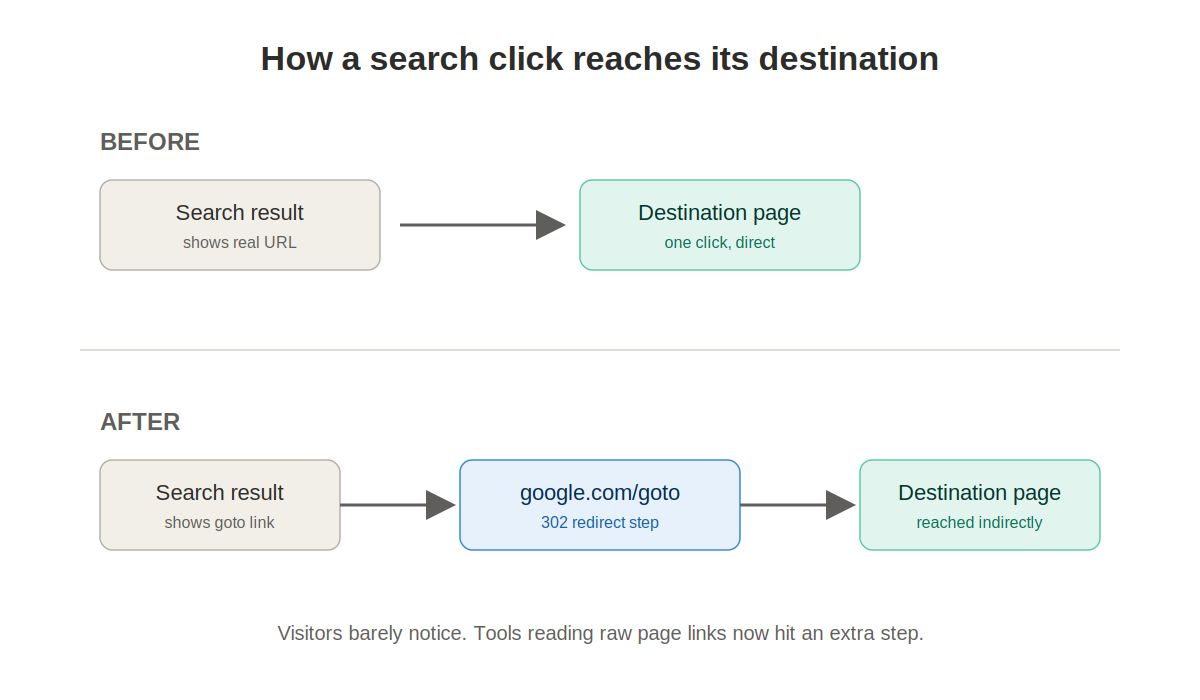
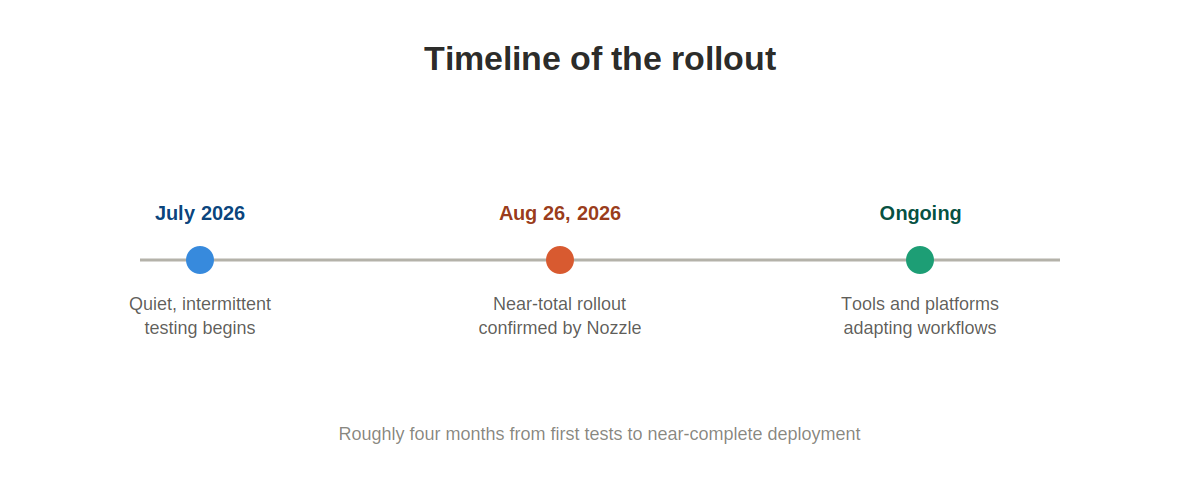
That assumption no longer holds. Google has confirmed it is routing search result clicks both organic listings and paid ads through an intermediate redirect, google.com/goto, before sending the visitor on to the real page via a standard 302 redirect. Testing began quietly around mid-2026, and by late August 2026, the change had rolled out widely across organic results.
For a human clicking a result, the experience is basically unchanged you land on the correct page in a fraction of a second, redirect included. The difference only shows up when you deliberately go looking for it, the way we just did with the hamrix.com test above.
This isn't a cosmetic UI tweak it's a deliberate technical barrier against automated scraping of search results at scale.
For years, an entire layer of tools has existed that reads Google's results pages directly, without any official partnership or API agreement with Google: rank checkers that tell you where you sit for a keyword, SEO platforms that compare your visibility against competitors, resold "search data" APIs, and increasingly AI products that pull live search results to generate answers for their own users. None of these tools access Google's data through a sanctioned channel; they simply read the page the same way a browser would.
Google has been fighting this kind of large-scale scraping for a while, including through direct legal action against some data-reselling companies. The goto redirect is the engineering-level version of the same fight: every tool that wants a clean destination URL now has to make an additional network request through Google's own servers first. That's slower, easier to rate-limit, and far easier for Google to detect and throttle at scale than quietly parsing static HTML ever was.
Rather than relying on general impressions, it's worth looking at what's actually been measured. Testing began quietly around July 2026, and by August 27, SEO data provider DataForSEO confirmed Google had widely rolled out goto URLs across organic search results specifically with a further update on August 28 extending destination-URL resolution to additional SERP features, including AI Overviews.
What's most interesting isn't just that the rollout happened, but how unevenly it's landed across different parts of a results page. According to DataForSEO's own tracking of the SERPs their API returns, once a vendor properly adapts, organic results can be almost fully resolved back to clean destination URLs but other SERP features are lagging noticeably behind:
The AI Overview figure is the one worth paying attention to. It suggests Google is rolling this change out unevenly across its own product surface, and that AI-generated answer boxes exactly the kind of feature increasingly used to answer questions without a click-through are currently the hardest part of the results page to resolve back to clean links. If you're trying to understand where your citations or brand mentions are showing up inside AI Overviews specifically, that's currently the messiest part of the picture.
If you're wondering whether this touches you specifically, here's the honest breakdown:
You'll likely notice something if: you or your agency use a third-party rank tracking subscription, you pull "share of voice" or competitor visibility reports, you've built any internal script or spreadsheet macro that reads Google's results pages, or you rely on an AI research tool that summarises live search results.
You won't notice anything if: you simply run a website and receive organic traffic visitors still land on your pages exactly as before, just via one extra invisible hop or you're a normal person searching Google day to day.
One reassuring detail from the data above: established SEO data providers had already identified this behaviour before the wider rollout and built a fix for organic results ahead of time. If your agency or tooling stack is on top of this, the disruption to your actual reporting should be minimal outside of AI Overview tracking specifically.
A few practical, immediate consequences worth knowing about:
Your analytics referrer data may shift. Some analytics platforms attribute traffic based on the referring URL. If a redirect layer changes how that referrer is passed, you may see a temporary shift in how "Google Organic" traffic is categorised in certain tools worth watching, not panicking over.
Rank tracking numbers may wobble for a few weeks but less than you'd think. Tools that read raw search result HTML need to adapt to the new redirect structure. The good news, based on the data above, is that well-maintained tools already resolve the overwhelming majority of organic results correctly. Where you're still likely to see noise is specifically in AI Overview visibility tracking, which remains the hardest part of the SERP to resolve cleanly right now.
Copy-pasted links from search results are no longer clean. If your team has a habit of grabbing a competitor's or your own URL straight from a Google results page for a report or an audit, you're now copying the wrapped goto link instead of the real address, unless you deliberately extract the destination parameter.
None of this changes fundamentally sound SEO or website practice. It changes how you should read your reporting dashboards for the next little while, and it's a reminder that any workflow built entirely on scraping rather than proper analytics and sanctioned tools is inherently fragile.
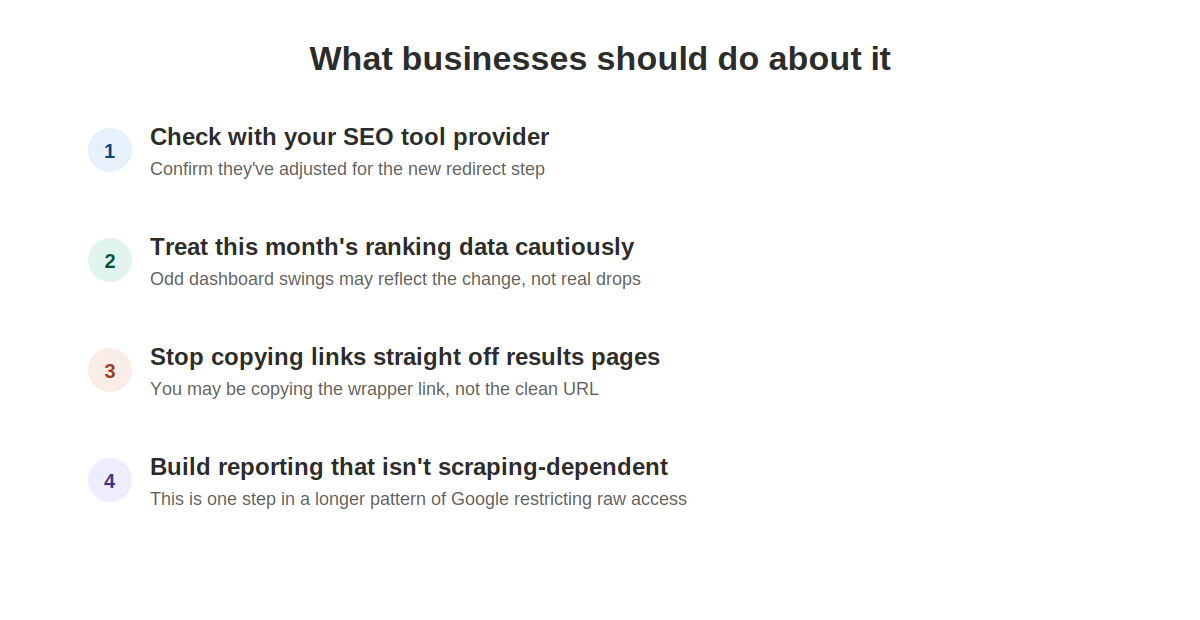
Run the hamrix.com test above on your own domain to confirm you're seeing the same redirect pattern. Check in with your SEO tool provider on whether their rank data has adjusted for the new redirect step and specifically ask how they're handling AI Overview tracking, since that's currently the weakest link industry-wide. Treat any unusual dip or spike in this month's search visibility reporting with some scepticism until it's confirmed against Google Search Console directly, which remains accurate. And stop pulling links straight off a results page for documentation always verify you have the clean destination URL, not the goto wrapper.
If your team handles this kind of thing manually today, this is exactly the sort of technical shift a proper SEO services partner should already be tracking on your behalf, rather than something you discover three weeks later from a confused dashboard.
Search results being harder to scrape isn't a one-off event it's the latest step in a longer trend. Over the past few years Google has steadily made its results pages more resistant to casual scraping: JavaScript-rendered content that needs a real browser to see, frequently shifting internal markup, and now a mandatory server-side redirect on every link. Each step individually looks small. Together, they represent a platform steadily tightening how freely its data can be read by anyone who isn't Google itself largely a response to the explosion of scraping-dependent AI tools built on exactly this kind of raw access. The fact that AI Overviews are currently the hardest SERP feature to resolve cleanly is a fairly pointed detail in that story.
For businesses, the practical takeaway isn't to panic about any single change like this one. It's to make sure your marketing and reporting infrastructure your website, your SEO strategy, and your digital marketing is built on properly sanctioned data sources (Google Search Console, Google Analytics, official ad platform reporting) rather than tools quietly scraping a page that could change its structure again at any time.
This is also worth flagging to your digital consulting partner if you have one it's exactly the kind of infrastructure shift that should be caught proactively, not discovered after a client asks why a dashboard looks strange.
Rollout and resolution figures referenced above are sourced from DataForSEO's public update on the goto rollout, current as of August 28, 2026.
We'll check your actual Search Console data against your current reporting tools and tell you honestly whether anything's actually changed or whether it's just noise from this update.
Get a Free SEO Check →
Full-Stack Developer with 4+ years of experience delivering SEO-ranked, high-performance web architectures and enterprise SaaS, FinTech & PropTech applications. Founder & CTO at Hamrix.
View Profile →