SEOAugust 31, 2026
Google's August 2026 Spam Update Was 82% More Disruptive Than Normal Here's What the Data Actually Shows

Google's August 2026 spam update officially began rolling out on August 18 at 9:27am Pacific and finished on August 21 at 1:49am Pacific a run of roughly two days and sixteen hours, making it the longest of the three spam updates Google has shipped so far this year. If you manage a website and watched your Search Console numbers dip or spike unexpectedly during that window, this update is very likely the reason.
In plain English
Every so often, Google runs a cleanup of its search results aimed at spammy or manipulative websites. This particular cleanup, in August 2026, shook things up far more than usual a lot more sites moved up or down the rankings than in a typical week, even ones that weren't doing anything wrong. If your website's traffic changed noticeably around August 18-21, this is very likely why.
What makes this one worth actually paying attention to rather than filing under routine search noise is how much bigger the swing was than normal.
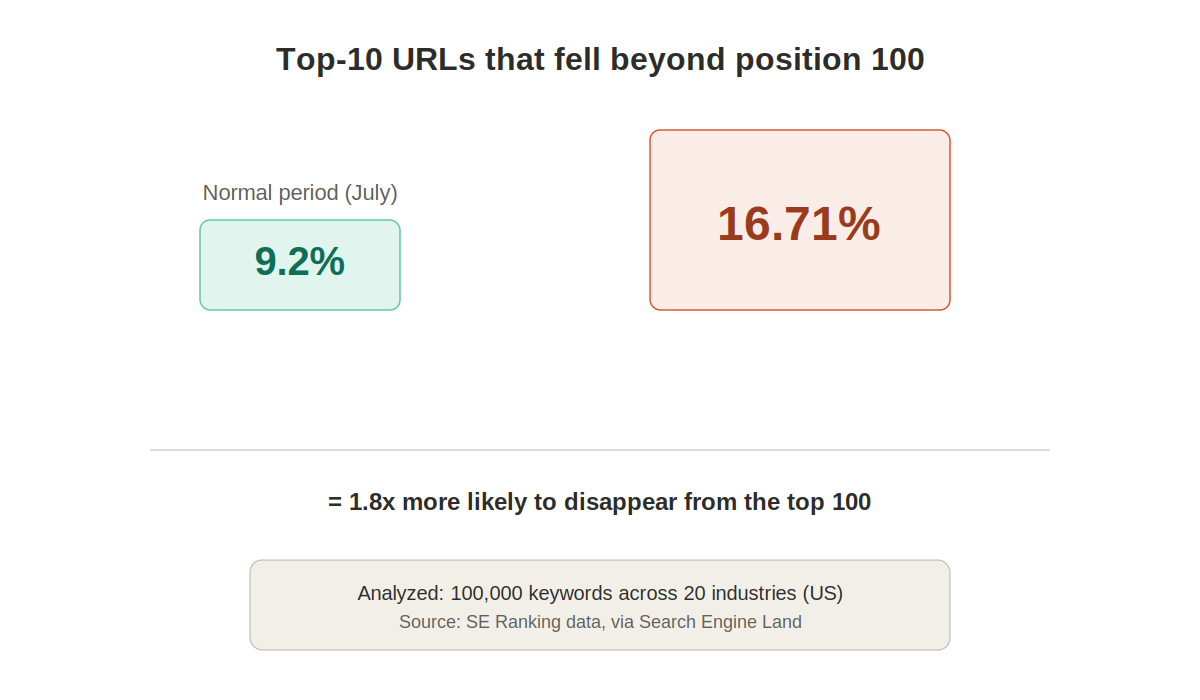
SE Ranking pulled organic Google results for the same 100,000 keywords across 20 different industries in the US, comparing rankings from immediately before the update (August 17) to immediately after (August 22), then measured that against a baseline period in late July when no update was running.
The results were stark. During the spam update, 16.71% of URLs that had been ranking in the top 10 for a given keyword fell beyond position 100 entirely compared to just 9.2% during the equivalent baseline period. In practical terms, a top-10 ranking URL was roughly 1.8 times more likely to essentially disappear from the results during this update than during a normal week. On the flip side, there was also a 12% increase in URLs jumping into the top 3 that hadn't even been ranking in the top 20 beforehand.
Every one of the 20 industries analysed including fashion, beauty, real estate, and healthcare showed significant movement. This wasn't a niche-specific correction; it touched the board broadly.
Here's the timeline in full, because the confusion around this update partly comes from how it overlapped with volatility that started before Google officially confirmed anything.
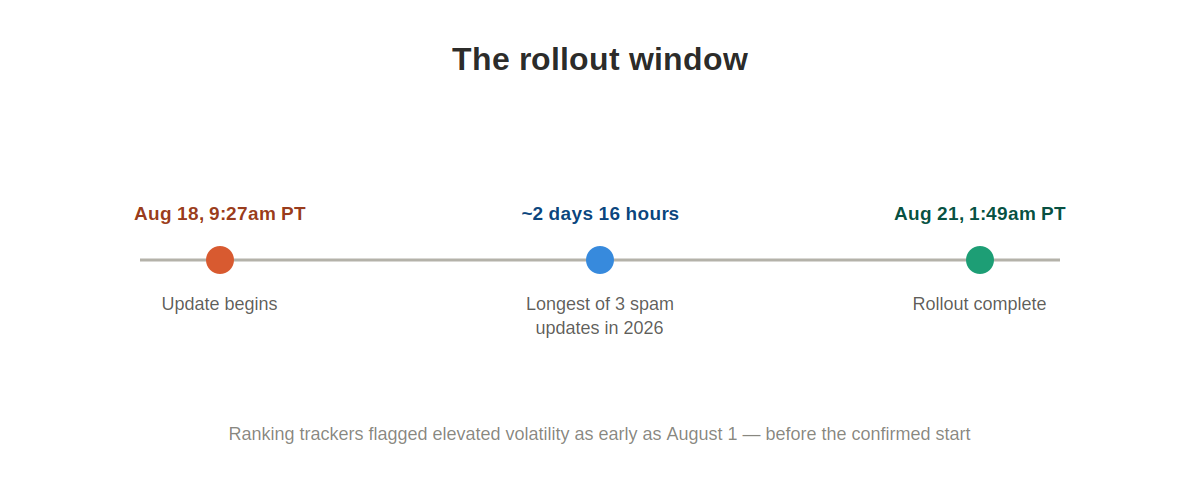
Ranking trackers Semrush Sensor, Mozcast, Ahrefs, and others had already been flagging elevated volatility from as early as August 1, well before Google confirmed anything was rolling out on the 18th. That means a chunk of the disruption people are blaming on "the spam update" may have started before it, and volatility has continued in the days since it officially completed, according to ongoing tracking from the SEO community.
It's worth being precise about what this kind of update is meant to catch, because "spam update" doesn't mean every affected site did something wrong.
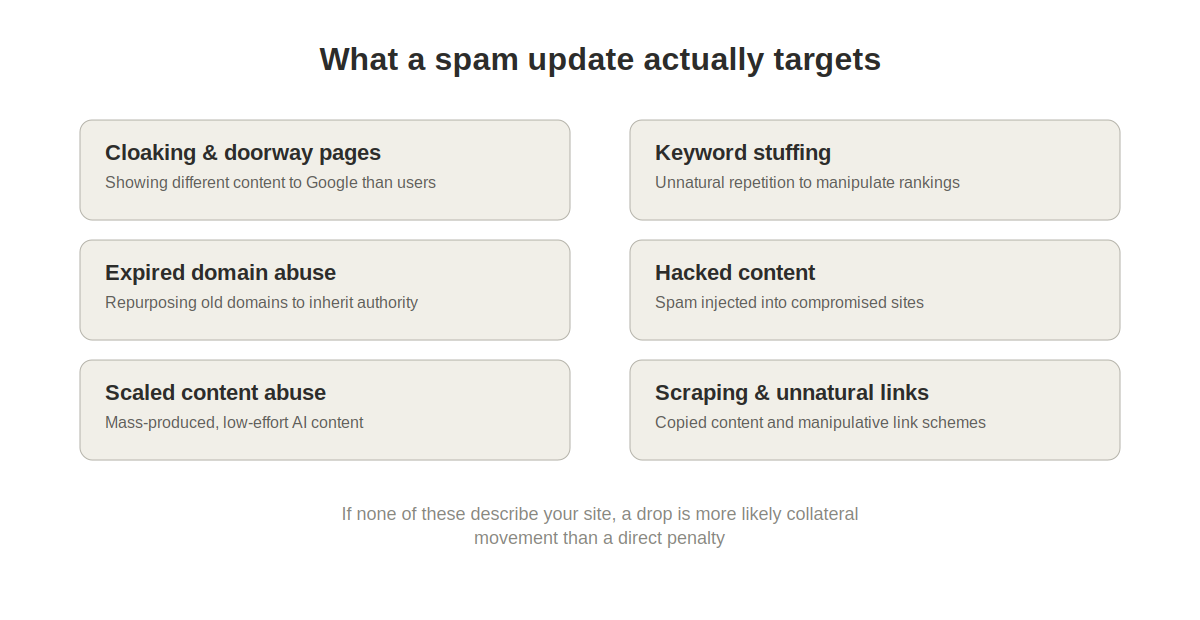
If your site doesn't engage in any of the practices above, a ranking shift during this window is more likely a side effect of broader recalibration than a direct penalty against you specifically. That said, "not spam" doesn't automatically mean "not affected." Rankings for sites near spam-flagged competitors, or sites that share technical or content patterns with genuinely low-quality pages, can move as collateral movement even without deliberate manipulation on their part.
Part of what's made this one hard to read is timing overlap, as shown in the timeline above. This overlapping pattern is exactly why panic-editing your content the moment you see a ranking drop is usually the wrong move. If a page was already mid-recovery from earlier, unrelated volatility and you rewrite it based on a snapshot taken during the worst of the swing, you risk introducing a fresh editing signal that extends the instability rather than resolving it.
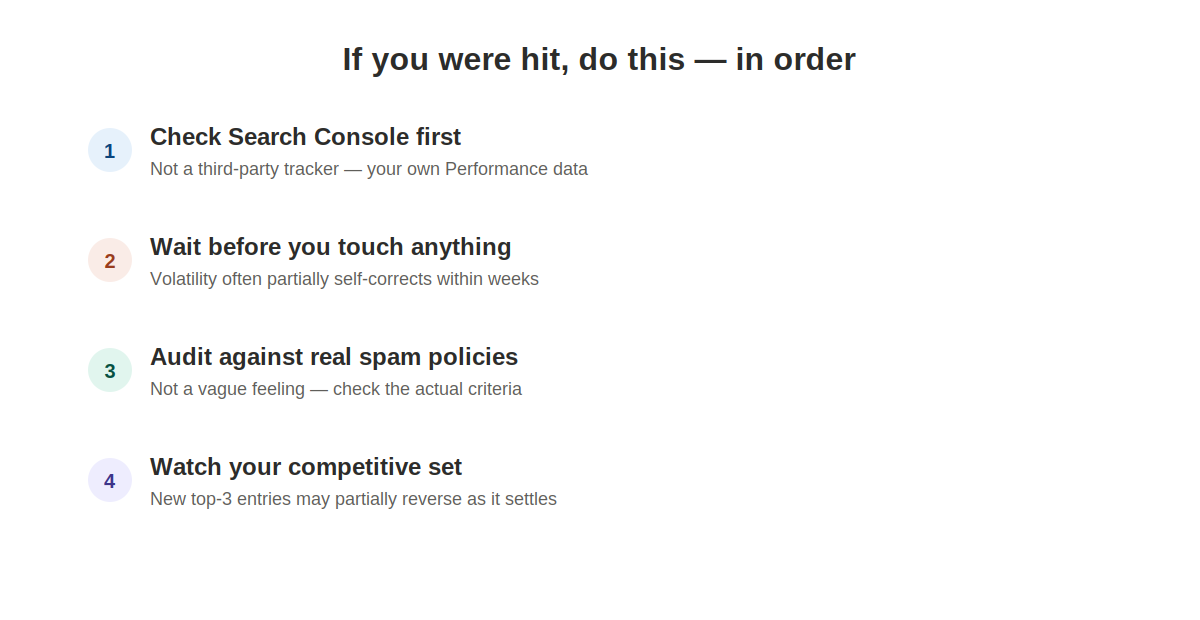
Check Search Console first, not a third-party tool. Third-party rank trackers sample keywords and can amplify noise; your own Performance report shows what's actually happening to your real traffic and impressions.
Give it time before you touch anything. Ranking volatility during and immediately after a confirmed update frequently partially or fully self-corrects within a couple of weeks as Google's systems finish settling. Rewriting or deleting a page during that window, based on data taken mid-volatility, is a common and avoidable mistake.
Audit honestly against Google's actual spam policies not a vague sense of "we might be too aggressive with SEO." Look specifically for scaled or low-effort content, unnatural link patterns, and anything that resembles doorway pages or cloaking, even accidentally introduced through a plugin, template, or third-party integration you didn't build in-house.
Watch your competitive set, not just your own numbers. If pages that had never ranked well suddenly jumped into your top 3 during this window, some of that movement may reverse as the update fully settles worth revisiting your competitive analysis in a few weeks rather than reacting to it today.
If you're not confident distinguishing "genuine algorithmic penalty" from "collateral noise from a broad update," this is exactly the kind of diagnosis a proper SEO services review is built for pulling your actual Search Console history against the update's known rollout window, rather than guessing from a single dashboard number.
This update didn't happen in isolation. It's landing at the same time Google has been quietly changing how search results themselves work at a technical level including routing every result link through a redirect before you reach the real page, a shift we broke down in detail in our piece on Google's goto redirect change. Neither change is dangerous on its own, but together they're a useful reminder: search infrastructure is shifting faster and more frequently than most businesses' SEO reporting habits have adjusted for.
This is the third spam update Google has shipped in 2026, following updates earlier in the year, and it's part of a broader pattern of increasingly frequent, increasingly aggressive quality recalibration across Search. Combined with the ongoing shift toward AI Overviews and AI Mode reshaping how and whether users click through to websites at all, the practical lesson for any business relying on organic search isn't to chase every individual update. It's to build a digital marketing foundation genuinely useful content, clean technical implementation, and a website built on sound fundamentals that's resilient to this kind of volatility by design, rather than one that needs a full audit every time Google ships an update.
If you manage SEO across multiple properties or markets and want a second opinion on whether recent movement reflects this update specifically, our digital consulting team can walk through your Search Console data against the confirmed rollout window.
We'll pull your Search Console data against the confirmed rollout window and tell you honestly what actually happened no guesswork, no unnecessary rewrites.
Get a Free Ranking Check →
Full-Stack Developer with 4+ years of experience delivering SEO-ranked, high-performance web architectures and enterprise SaaS, FinTech & PropTech applications. Founder & CTO at Hamrix.
View Profile →